
Matdo Grade
Paper homework.
Graded on your iPhone/iPad.
Photograph your child’s finished homework. Review marks, correct answers, and explanations so you can help them try again.
For Parents. By Parents.
Coming Soon!
Sign up forPre-Launch TestingQualified pre-launch testers get 1,000 free units.
- No answer key to upload
- No assignment to create
- Feedback on your page
See a real checked page
Compare a completed worksheet with its actual Matdo Grade result. Start with the decimal answers below, or choose another example.
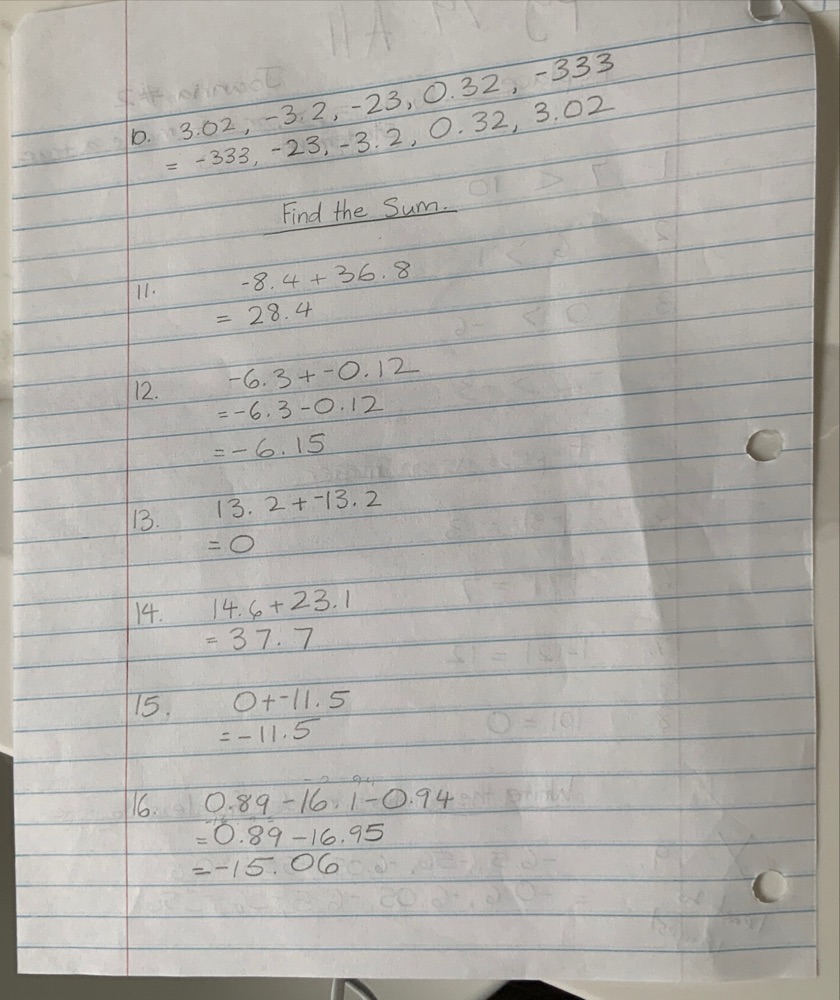
The values are correctly ordered from smallest to largest.
Correct steps
- 1Order the numbers from least to greatest.−333 < −23 < −3.2 < 0.32 < 3.02
Possible mistake
Nothing to flag — the answer is correct.
The sum of −8.4 and 36.8 is correctly calculated as 28.4.
Correct steps
- 1Add the positive and negative decimals.−8.4 + 36.8 = 36.8 − 8.4 = 28.4
Possible mistake
Nothing to flag — the answer is correct.
The student misaligned the decimal places when adding 0.3 and 0.12, arriving at −6.15 instead of −6.42.
Correct steps
- 1Add the two negative decimals.−6.3 + (−0.12) = −(6.30 + 0.12) = −6.42
Possible mistake
At step 1The student added 3 and 12 improperly to get 15 instead of aligning decimal places (0.30 + 0.12 = 0.42).A best guess from what is written on the page.
The sum of opposites is zero.
Correct steps
- 1Add opposite numbers.13.2 + (−13.2) = 0
Possible mistake
Nothing to flag — the answer is correct.
The two decimals are correctly added together to get 37.7.
Correct steps
- 1Add the two positive decimals.14.6 + 23.1 = 37.7
Possible mistake
Nothing to flag — the answer is correct.
Adding zero leaves the value unchanged at −11.5.
Correct steps
- 1Add negative 11.5 to zero.0 + (−11.5) = −11.5
Possible mistake
Nothing to flag — the answer is correct.
The student incorrectly calculated −16.1 − 0.94 as −16.95 rather than −17.04.
Correct steps
- 1Combine the negative terms first.−16.1 − 0.94 = −17.04
- 2Subtract from 0.89.0.89 − 17.04 = −16.15
Possible mistakes
At step 1The student added 16.1 and 0.94 incorrectly as 16.95 instead of 17.04.At step 2The student made an arithmetic error when evaluating 0.89 − 16.95.A best guess from what is written on the page.
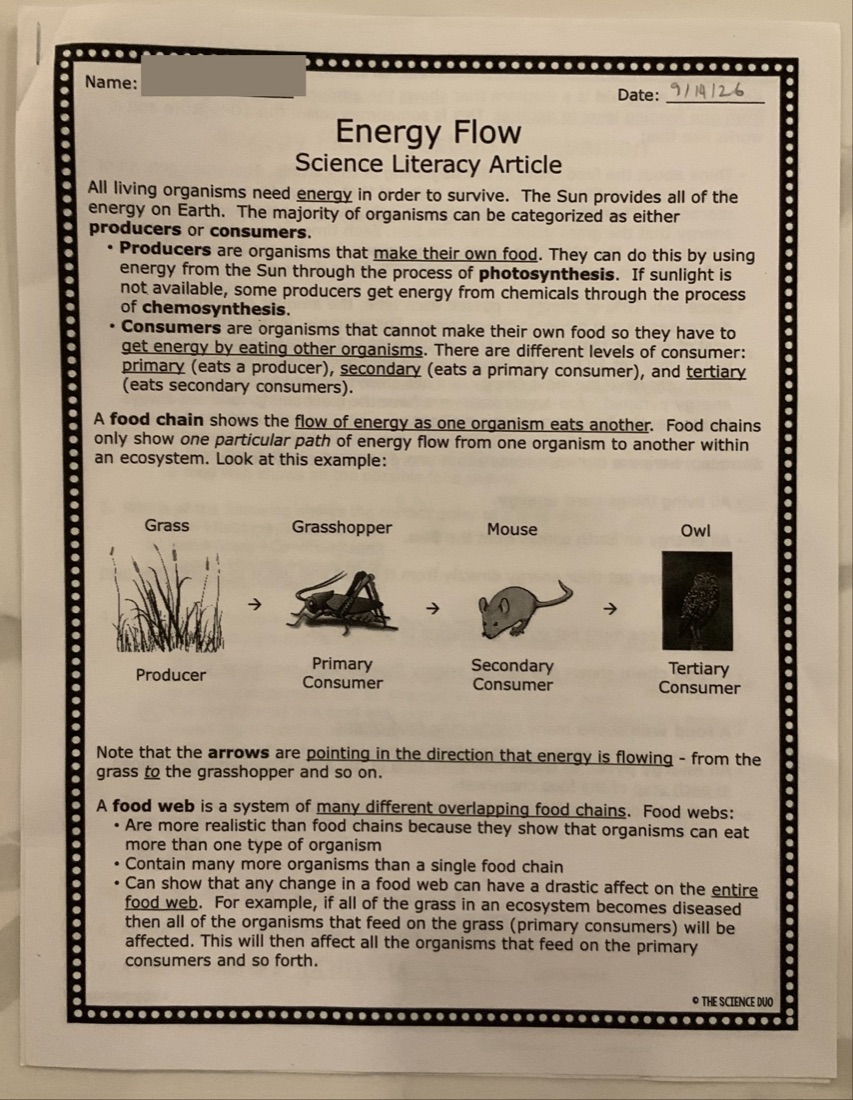
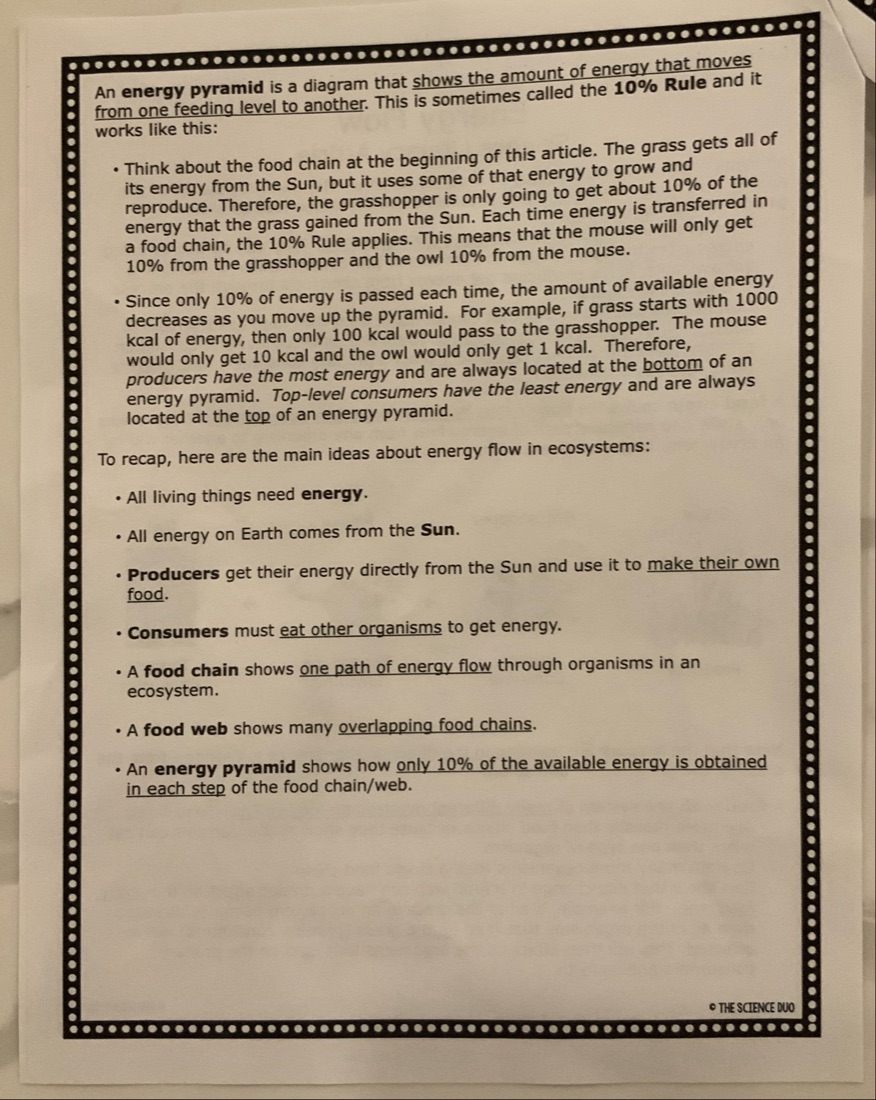
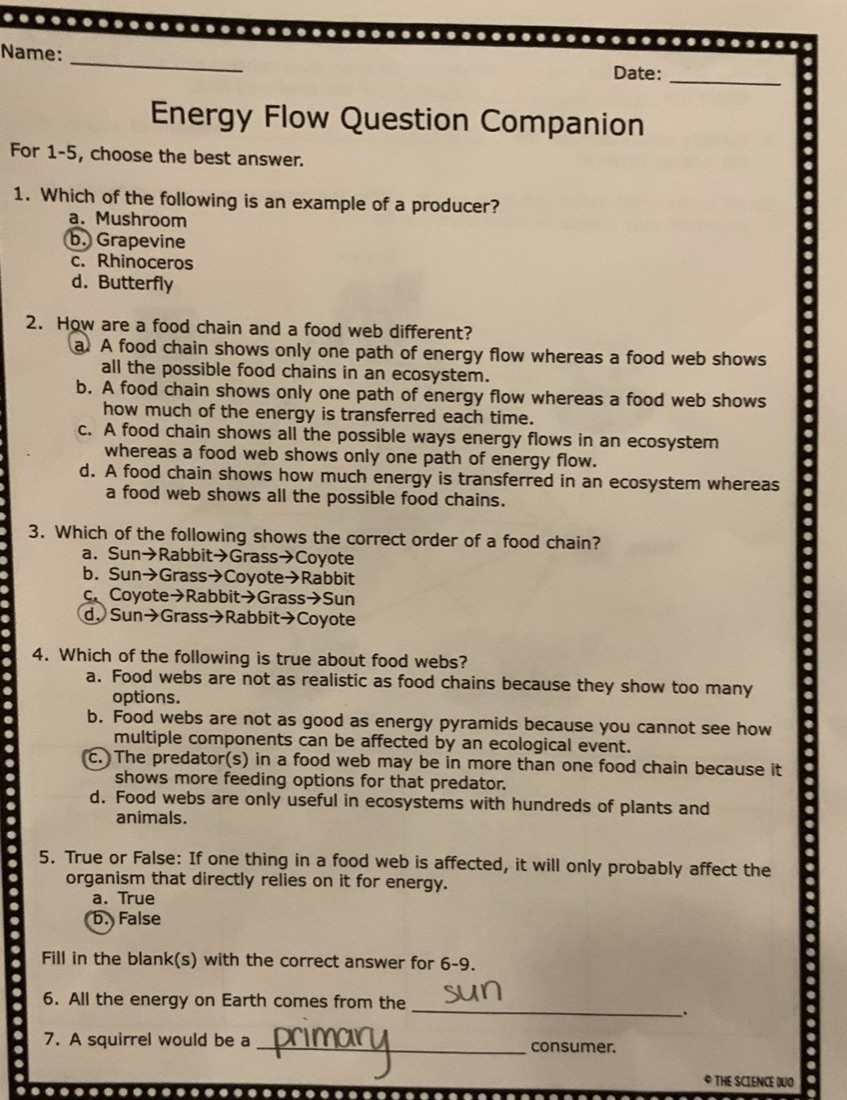
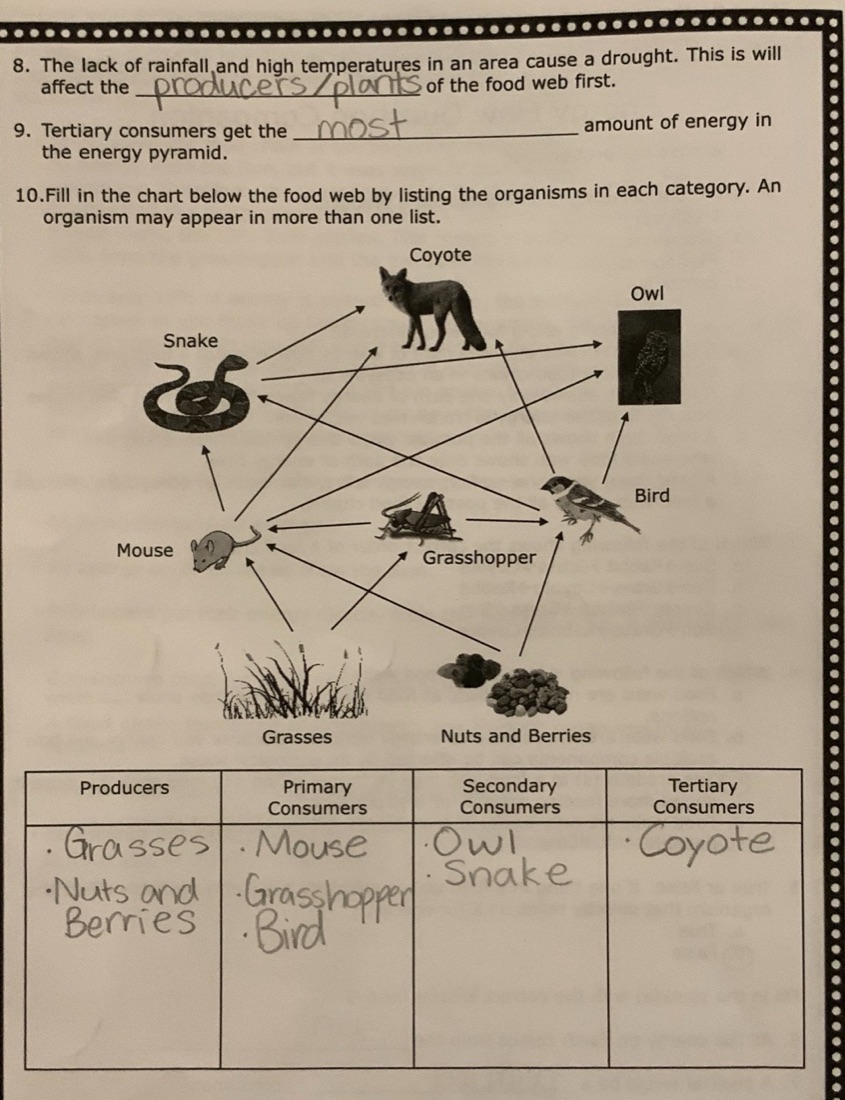 Read as context · not markedRead as context · not markedQuestion 10 was graded but isn’t marked on the page
⚠ Not marked on the page — its position on the sheet couldn’t be identified
This four-page example reads two passage pages as context, then checks the questions. Question 10 is listed in the details even though its position could not be identified.
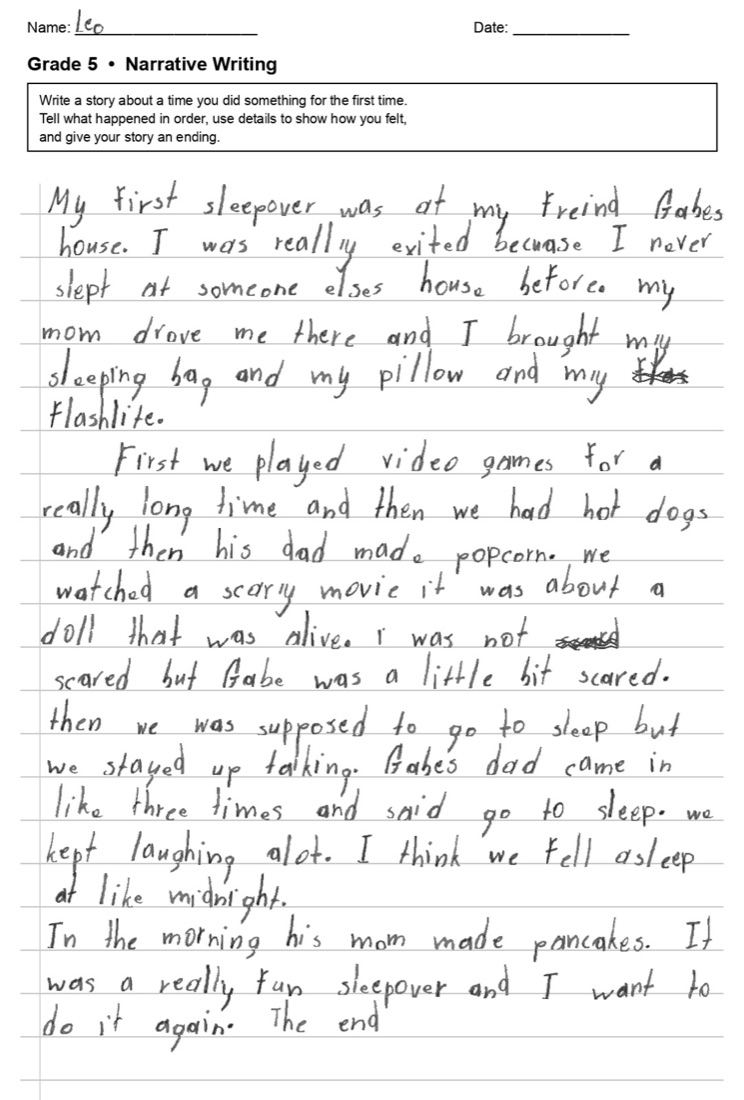 Paragraph 1Leo establishes the topic right away and describes what he packed to set the scene effectively. Combining the last couple of clauses into two shorter sentences would help the rhythm flow even better.Paragraph 2Leo builds strong momentum by listing fun sleepover activities and including lively details like Gabe being scared of the movie. Replacing repetitive sentence starters such as ‘and then’ would make the narrative flow more smoothly.Paragraph 3Leo wraps up the experience neatly by mentioning the morning breakfast and sharing how much he enjoyed the night. Adding a detail about what kind of pancakes or conversation they had at breakfast would give the ending even more flavor.Misspelling and missing possessive apostrophe
Assessed againstClerical · Grammatical · Composition
Summary
Leo writes about going to his friend Gabe’s house for his very first sleepover. He describes playing video games, eating hot dogs and popcorn, watching a scary movie about a doll, and laughing until late at night. The story concludes the next morning with pancakes and Leo expressing that he wants to do it again.
Rubric
- ClericalLeo provides his name and indents his paragraphs, but leaves the date blank and does not include a title.Partly met
- GrammaticalLeo struggles with possessive apostrophes, capitalization at sentence starts, run-on sentences, and subject-verb agreement.Partly met
- CompositionLeo tells a clear, chronological narrative with a defined beginning, middle, and end that fulfills the prompt well.Met
Paragraph by paragraph
Spelling and grammar
Overall
Leo wrote an engaging, complete personal narrative that captures the excitement of his first sleepover with plenty of relatable details. His sequencing is clear and easy to follow from the initial arrival to the morning pancakes. Working on sentence punctuation and possessive apostrophes will help polish his storytelling even further.
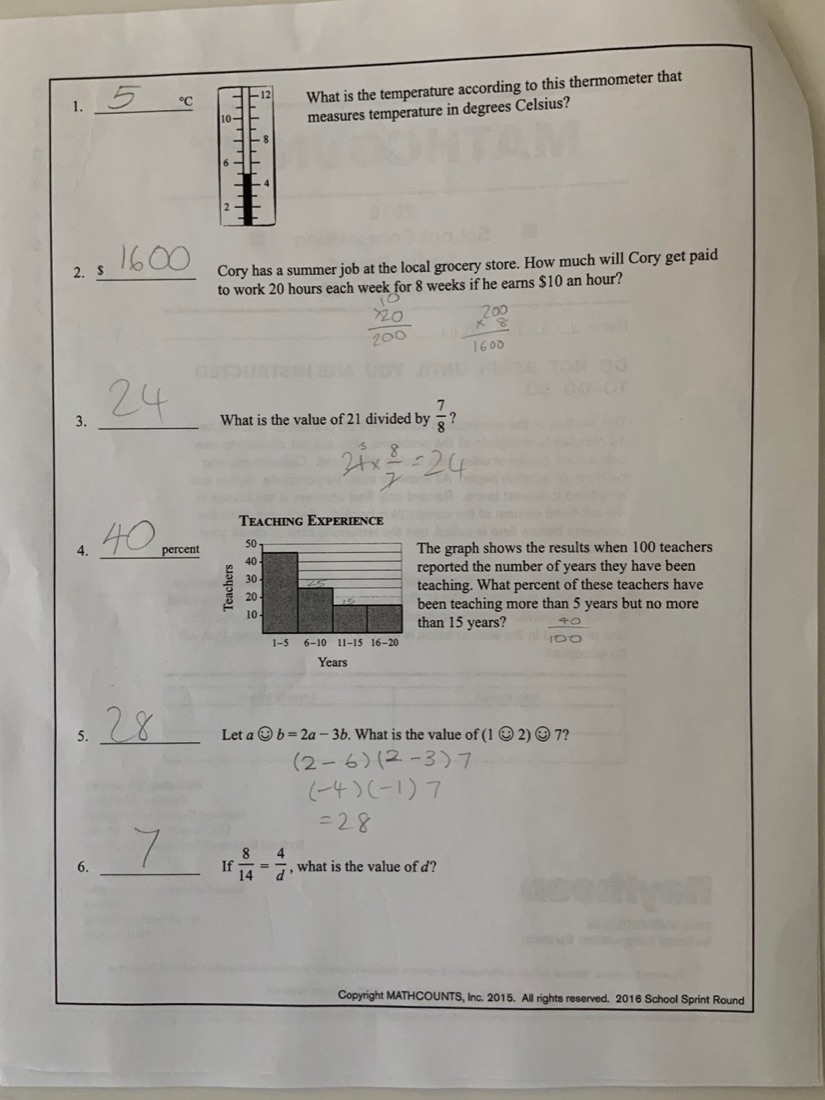
The thermometer reads at 5 degrees Celsius.
Correct steps
- 1Observe the thermometer level, which is halfway between 4 and 6.(4 + 6) / 2 = 5
Possible mistake
Nothing to flag — the answer is correct.
Multiplying 20 hours by 8 weeks by $10 per hour gives $1600.
Correct steps
- 1Multiply weekly hours by the number of weeks to find total hours.20 × 8 = 160
- 2Multiply total hours by the hourly rate.160 × 10 = 1600
Possible mistake
Nothing to flag — the answer is correct.
Dividing 21 by 7/8 yields 24.
Correct steps
- 1Divide 21 by 7/8 by multiplying by the reciprocal.21 × 8/7 = 3 × 8 = 24
Possible mistake
Nothing to flag — the answer is correct.
The categories for 6–10 and 11–15 years total 40 teachers, which is 40 percent of 100.
Correct steps
- 1Read the number of teachers in the 6–10 and 11–15 year categories from the graph.25 + 15 = 40
- 2Calculate the percentage out of the 100 total teachers.40 / 100 × 100 = 40
Possible mistake
Nothing to flag — the answer is correct.
Applying the operation sequentially gives −4 ☺ 7 = −29.
Correct steps
- 1Evaluate the operation inside parentheses using the definition a ☺ b = 2a − 3b.1 ☺ 2 = 2(1) − 3(2) = 2 − 6 = −4
- 2Apply the operation to the result and 7.−4 ☺ 7 = 2(−4) − 3(7) = −8 − 21 = −29
Possible mistake
At step 2The student treated the operation as multiplication of differences rather than applying the defined operation again.A best guess from what is written on the page.
Simplifying 8/14 gives 4/7, so d = 7.
Correct steps
- 1Cross-multiply or simplify the fraction 8/14 to 4/7 to solve for d.8/14 = 4/7 → d = 7
Possible mistake
Nothing to flag — the answer is correct.
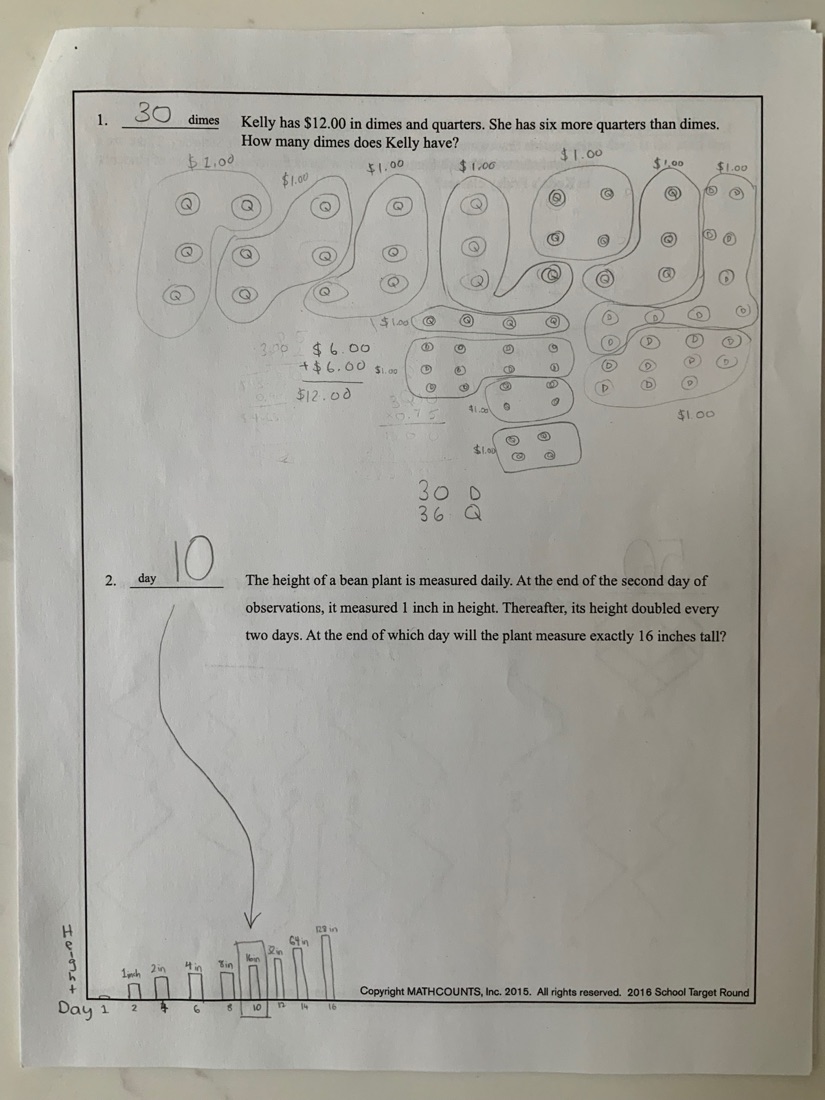
The system of linear equations correctly yields 30 dimes.
Correct steps
- 1Set up an equation where d is the number of dimes and d + 6 is the number of quarters.0.10d + 0.25(d + 6) = 12.00
- 2Distribute and simplify the equation.0.35d + 1.50 = 12.00
- 3Solve for d.0.35d = 10.50 ⟹ d = 30
Possible mistake
Nothing to flag — the answer is correct.
Doubling every two days reaches 16 inches on day 10.
Correct steps
- 1Track the height on even days starting with day 2 at 1 inch.Day 2: 1 in
- 2Double the height every two days until 16 inches is reached.Day 4: 2 in, Day 6: 4 in, Day 8: 8 in, Day 10: 16 in
Possible mistake
Nothing to flag — the answer is correct.
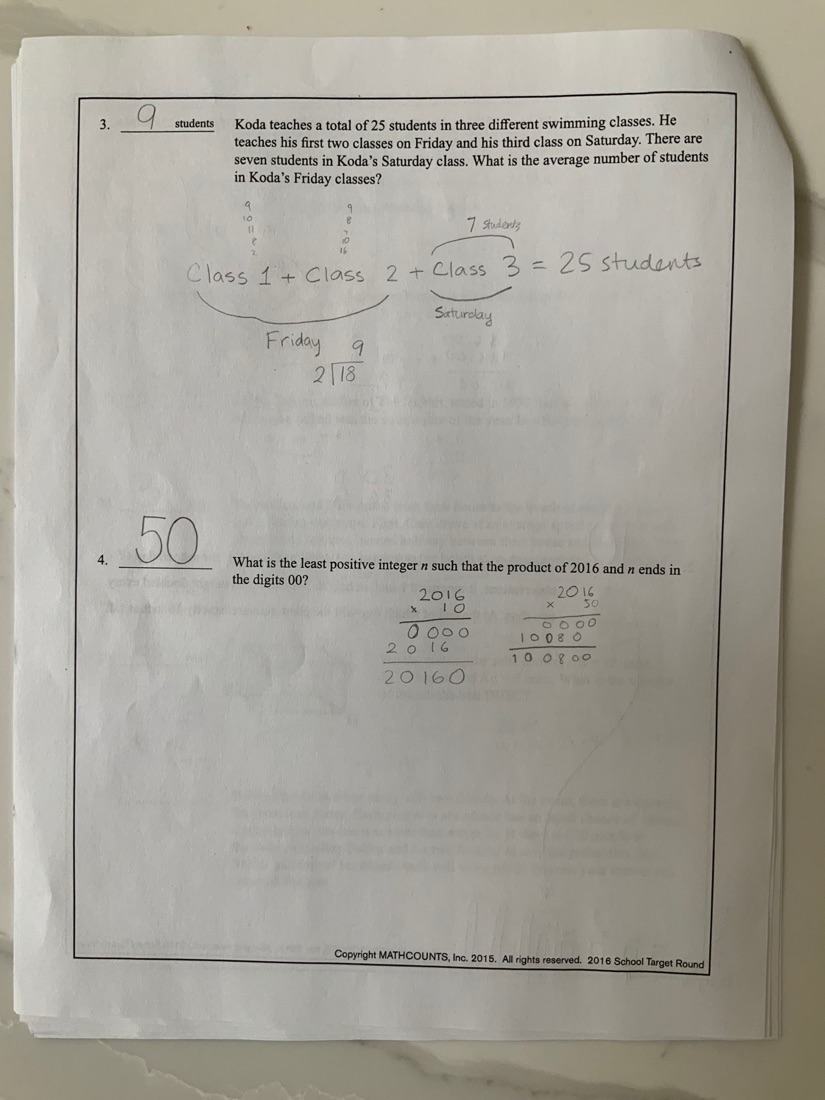
Subtracting 7 from 25 gives 18, and dividing by 2 yields an average of 9 students.
Correct steps
- 1Subtract the Saturday students from the total to find the number of students on Friday.25 − 7 = 18
- 2Divide the Friday total by the 2 classes to find the average.18 / 2 = 9
Possible mistake
Nothing to flag — the answer is correct.
The least positive integer is 25 since 2016 × 25 = 50400 ends in 00.
Correct steps
- 1For 2016 × n to end in 00, it must be divisible by 100.2016n ≡ 0 (mod 100)
- 2Factor both numbers into prime factorizations: 2016 = 2⁵ × 3² × 7 and 100 = 2² × 5².2016 = 2⁵ × 3² × 7
- 3Determine the factors needed so that the product includes 5² = 25. Since 2016 has no factors of 5, n must be a multiple of 25.25 | n
- 4Test the smallest multiples of 25: 2016 × 25 = 50400, which ends in 00.n = 25
Possible mistake
At step 4The student tested 10 and 50 but overlooked 25, which is smaller than 50 and also makes the product end in 00.A best guess from what is written on the page.
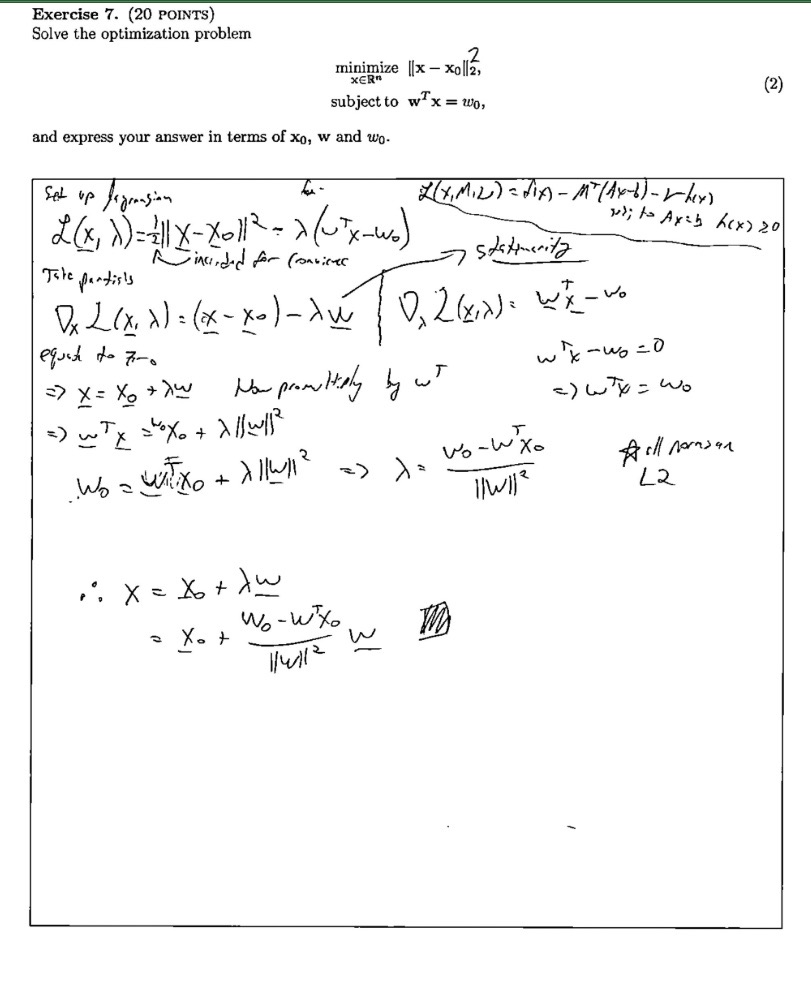
The student correctly set up the Lagrangian, found the stationary point, solved for the Lagrange multiplier, and substituted back to get the optimal solution.
Correct steps
- 1Formulate the Lagrangian using the objective function and equality constraint.L(x, λ) = ½‖x − x₀‖₂² − λ(wᵀx − w₀)
- 2Set the gradient with respect to x to zero to find the stationary point.∇ₓL(x, λ) = (x − x₀) − λw = 0 ⟹ x = x₀ + λw
- 3Apply the constraint wᵀx = w₀ by multiplying by wᵀ.wᵀx = wᵀx₀ + λ‖w‖₂² = w₀ ⟹ λ = (w₀ − wᵀx₀) / ‖w‖₂²
- 4Substitute λ back into the expression for x.x = x₀ + (w₀ − wᵀx₀) / ‖w‖₂² · w
Possible mistake
Nothing to flag — the answer is correct.
How it works
Take a photo of the finished homework; see the marks on the iPad.

Photograph the homework
Capture the finished work, including the questions and any reading passage.

Review the checked page
Review the marks, correct answers, and worked explanations together.

Help your student try again
Let your student use the feedback to make another attempt on paper.
Tips for reviewing feedback
- Review the feedback before relying on it.
- If a result seems wrong, compare the student’s answer shown in the details with the original page.
- Capture a clearer photo or include missing instructions when needed.
Subjects

Math

Essay

Reading

Social Studies

Chemistry

Physics

Biology

History
Your AI grading assistant
Scan homework. Understand mistakes. Help learning move forward.
Pricing
For iPad and iPhone.
Free
$0
100 units, one time
About 10 pages of Brief grading
Free trial
Lite
$4.99/ month
750 units a month
About 75 pages of Brief grading
Parents helping one child
Plus
$9.99/ month
2,000 units a month
About 200 pages of Brief grading
Tutoring several children
Pro
$19.99/ month
4,500 units a month
About 450 pages of Brief grading
Teacher
Max
$39.99/ month
10,000 units a month
About 1,000 pages of Brief grading
Busy Teacher
Top-Up: 1,000 extra units for $6.99, never expire.
Pre-launch testing: families who help us test Matdo Grade before launch get 1,000 free units. Sign up for pre-launch testing.
A few questions before you start
How paper homework, explanations and saved work fit together.
Do I need an answer key?
Why not just use ChatGPT?
You certainly can. But Matdo is built for one job: checking finished homework.
- Take a photo, and we do the rest. No answer key, no prompts, nothing to type. We’re parents too, and we know how long checking homework takes.
- Marks on the paper. See right on the page which answers need another look, without going back and forth between a chat and the worksheet.
- Step-by-step explanations that help you help your child, not just hand over answers.
- Made for parents. A simple app built around homework, not a chat window.
Like any AI, Matdo can make mistakes, so give the marks a quick look.
What kinds of homework can it check?
What if a result seems wrong?
Is my child’s homework kept private?
Need more detail? Read the support guide or contact Matdo Lab.